

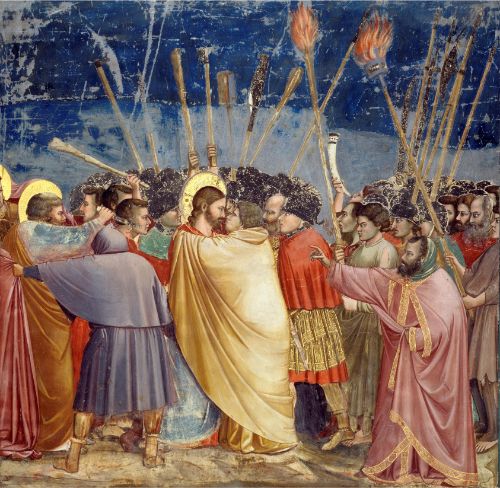
On the Tuesday and Wednesday of Holy Week each year, we read in the gospel for Mass about Judas and his plan to betray Jesus. “What will you give me if I deliver Him to you?” (Matthew 26:15). We don’t like to look too closely at Judas. We don’t like to think about why his betrayal of Jesus has anything to do with us—it makes us uncomfortable.
Not that I like what I see, but this year, I have the grace to be a little more ready to see the Judas in myself. I am a little more familiar with the ways I can tend to betray Jesus by my predominant faults and sins.
I really appreciate an insight received in a homily that Judas’ betrayal was not necessary to Jesus fulfilling His mission. That is important. He would have found a way of dying for us even if Judas had not sinned against Him. The chief priests, Pharisees, and scribes all hated Him and were looking for ways of tripping Him up, trapping Him, arresting Him, so they could destroy Him. He did not need Judas to betray Him.
The problem was, however, Judas had already betrayed Jesus by the very way he approached his discipleship. He was calculating and self-serving. Think of his reaction to Mary of Bethany who extravagantly “wasted” perfumed oil by pouring it on Jesus’ feet. “Why was this perfume not sold? It could have brought three hundred silver pieces, and the money given to the poor” (John 12:5). He was not concerned for the poor, John tells us, but for himself.
I can see my own betrayals of Jesus in the calculating and self-serving ways I can approach my own discipleship. I was in the kitchen one day, working alone on preparing dinner and cleaning the sink, countertops, etc. I was contemplating Jesus as I worked, with the melody from the hymn of Morning Prayer still stuck in my head. I thought I was doing really well. Then a sister came into my work area—notice I said my work area instead of the kitchen—to wash a dirty dish just as I was about to start cleaning the sink, and what did I do? I snapped at her. So was I immersed in Jesus or in myself? Clearly, I was more concerned in the moment with what I was doing than with the needs of my sister.
Michael Card wrote a song many years ago that continues to haunt me whenever I think about Judas. Some of the words were: Now Judas, don’t you come too close/ I fear that I might see/ the traitor’s look upon your face/ might look too much like me.
Ah, yes, Judas makes us uncomfortable, but that is because we are all too familiar with the very things for which we tend to judge and criticize him. But unlike Judas, we don’t have to get stuck in our guilt and shame. We can trust that Our Savior can use our betrayals just as He used Judas’ to bring about His most wonderful work—the work of our redemption.
Sr. Mary Catherine, T.O.R.
