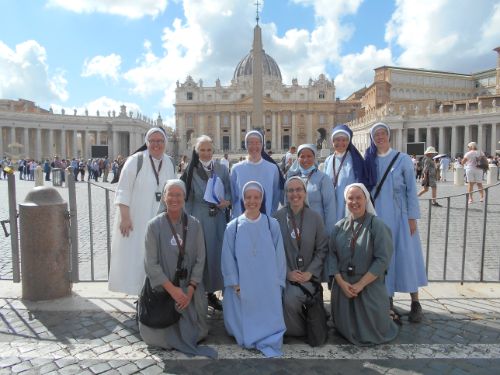
Why is Rome called “the heart of the Church”? It is certainly the seat of the hierarchy, a place where the Church has deep roots, and a place for much theological study and training. But “heart”? I might be more prone to consider the beating heart to be the family or the parish or the religious community, where life happens, where prayer happens. I spent two weeks in Rome recently for formator classes and pilgrimage, and it provided abundant opportunity for me to consider this question and experience it for myself.
My time taught me that it can, indeed, be called the heart, if the heart is the essence of a thing. Rome is what it is because of its martyrs. Rome is also a visible sign of the unity in diversity that is a mark of the Church. And, quite simply, it’s home for all Catholics. I experienced these on a personal level.
One of the many highlights of my time in Rome was going on a guided tour to the excavations under St. Peter’s Basilica (the Scavi tour), in which I came as close as one can to what we think are the bones of St. Peter. I was so moved as our guide explained how countless other tombs were discovered near the remains of this saint, crucified upside down for love of Christ. All these dead wanted to be buried close to this holy place. This set a tone for me as we visited the catacombs and tombs of other martyrs - how Christians do not and should not fear death, since Christ has gone before us through death into life. In St. John Lateran, the apostles are depicted in marble, confidently holding the instruments used to put them to death, now signs of victory and hope. Paul, Sebastian, Cecilia, Clement and Ignatius, Praxedes and Pudentiana, Agnes, Bartholomew and more witnessed just as Peter did and richly add to the holiness of this city.
Rome is a city best experienced on the streets, as chaotic as that can be. In a matter of seconds, you may pass groups of people speaking Italian, French, German, Chinese or English. While waiting for confession one day, I met Fr. Oreste, a priest from Rwanda, who offered me his place in the line. As my group walked in the doors of the Pontifical University of the Holy Cross each morning, we were flanked by priests, seminarians and lay women from around the world. Everyone greeted us with hearty “Buon Giornos” in various accents. We laughed when we kept running into the same group of Chinese young adults, and eventually took a picture together. They were overjoyed to meet us and earnestly asked us to pray for the Church in China. Of course, the Wednesday audience we attended was very much a multi-lingual experience. The Holy Father’s chosen topic was his recent visit to Kazakhstan, which emphasized even more to me the universality of the Church. I was especially struck by the desire of those I met (especially my professors and the American sisters who work at the Vatican) to be one with the Church and the Holy Father at this point in time - “one in heart and mind” (Acts 4:32). I think being in Rome can be like standing back to look at an entire impressionist painting. If you’re too close, all you see are different splotches of paint. But with a broader, universal perspective, you can see the beauty of the whole.
Since it wasn’t my first time in Rome, I experienced my visit as a return. I didn’t know how I would feel, three and a half years since my last visit. I was seeing it in a new context, with new people, in a different season, but in every other way it was as I remembered it. After the Scavi tour, we came back up into the main basilica of St. Peter’s. When I walked in and saw the Pieta on my right, the vast nave, and a sunset glow shining through the alabaster Holy Spirit window ahead of me, I felt a warm sense of home that I couldn’t have fabricated. And a few nights before I left, I felt an urge to go for an evening jog down the Corso Vittorio Emmanuele. I didn’t know how far I’d make it. Soon, after weaving through foot traffic and waiting for countless crosswalks, I found myself running straight down the middle of the Via Conciliazione toward the encircling arms around St. Peter’s Square. I stopped in front of the obelisk and drank from the water fountain, all the time staring at St. Peter’s, lit up against the twilight sky. Needless to say, it was hard to turn around and leave that sight, but I know I will always be welcome.
Rome stands as a paradox. Though built over an ancient necropolis and the burial place of a man killed by earthly power, St. Peter’s is a sign of the glory of the Resurrection. Though the hierarchy, religious and laity are very much made up of imperfect, diverse and often divided humanity, she, the Church, the body of Christ, is one. Rome, I think, is a symbol of that unity. And though many Catholics may never literally cross the Tiber, they all have a home in Rome, a sign of their home in the heavenly Jerusalem.
-Sr. Mary Gemma Harris, T.O.R.
