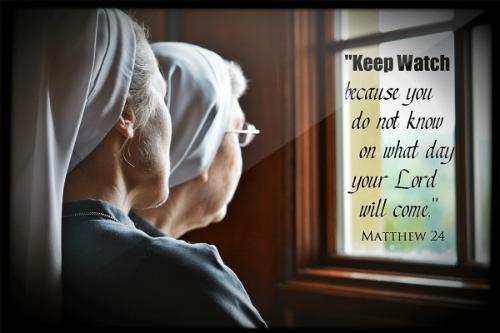
Jesus said to his disciples: Be watchful! Be alert! You do not know when the time will come. (Mk 13:33)
Advent is, by far, my favorite time of the liturgical year. Why? It could be hard to understand, especially now, given that the readings for the early weeks of this season seem a far cry from the refrains of the world, where we hear crooning over cozy fireside moments and magical memories, instead of the anthems we hear in the Scriptures these days.
In some respects, it’s a mystery even to me why I love Advent so much. I love the call of the season for a Savior. I love that out of darkness and hopelessness, we will eventually see “the dawn from on high break upon us.” (Luke 1:78) But what about now, when we’re hearing more about the terrifying last days, and being told in no uncertain terms that we need to be ready, because we know not the day nor the hour?
I recently heard a homily that helped me with this seeming tension. The priest spoke about the parable in Matthew’s gospel (Mt. 25:14-30) where the master goes on a journey and entrusts his servants with talents. The last servant, as we know, did not do what his master would have wanted him to do with his talent. He buried it, incurring his master’s anger and ultimately finding himself cast out into the darkness. The observation was made that the servant makes some assumptions about the master - and perhaps these assumptions were not fully accurate. The servant says, “I knew you were a demanding man…” He then says that because of this “knowledge,” his “fear” caused his inaction of burying the talent.
While this parable is certainly a stark warning to be ready, and to be about the Lord’s business, I also heard something else from these lines. I began to wonder how much the servant actually knew his master. He says that “I knew you were demanding…” Perhaps so. However, this so-called knowledge of his master leads to behavior that ultimately was not for the servant’s good. It made me reflect on how much I do this as well. How often do I say to the Lord, “I know that You will say this, or answer me this way, or demand such-and-such from me.” And many times, when I operate out of those assumptions, I do end up behaving out of fear: fear of punishment, fear of my own inability, or fear of the pain of the legitimate demands of the Christian life.
It brings me back to the original question: how much do I know the Master? For if I truly know Him, it seems to me that this knowledge will not lead to (inappropriate) fear as much as to surrender, and a deeper trust in Him who is the only One who will help me make good on the “talents” He’s entrusted to me. The Christian life is demanding. St. John Paul II says beautifully:
“Genuine love… is demanding. But its beauty lies precisely in the demands it makes. Only those able to make demands on themselves in the name of love can then demand love from others.” (Message to the Young People of Cuba, 23 January 1998)
My Lord and Master does make demands on me - but nothing that He has not first allowed to be demanded of Himself. When I remember this, I find that I can more easily approach Him now - while there is “still time.” I can beg for the grace I need to be always “concerned about the things of the Lord” (1 Cor 7:34) and found watchful and ready. I will not fear to come to Him and ask for help, or to ask for forgiveness when I’ve failed. And the more I do that, the more I will come to know Him, and be able to recognize His voice and His face. And in this way, I need not fear Him when He comes at the end of time, for I will have already learned what it is to dwell with Him and recognize his voice. St. Elizabeth of the Trinity says, “Is it not a comfort to think that He who is to be our Judge dwells within us throughout our miseries, to save us and to forgive our sins?”
And so even in these early weeks of Advent, where the tone is more disconcerting than comforting, I find courage and hope, knowing that this time is a call to draw close to Him now and to come to know Him, and thereby love Him more deeply, even the sweet demands of His love.
- Sr. Anna Rose Ciarrone, T.O.R.
