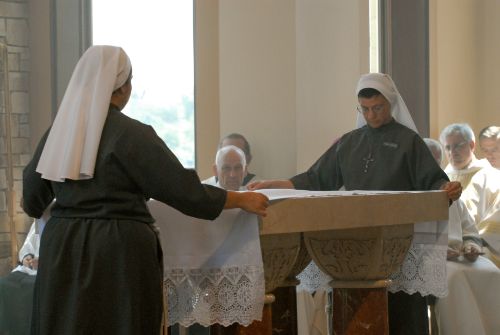
A number of years ago at the Easter vigil at Franciscan University of Steubenville, when the Gloria was being sung, amidst the ringing of bells, joyful voices, and flowers being brought up the aisles, I was deeply moved as two of the altar servers with big smiles brought forth the fresh white altar linens that had been prepared for the celebration. Holding onto each of the corners, they placed it reverently and carefully upon the bare altar. There was a spirit of joyful anticipation that seemed to be almost tangible, not only in their faces but also as if dripping in the air.
All of the joyful sounds, lights, and voices faded into the background as I saw this ritual in a whole new light. It was as if the Lord was saying “The bridal chamber is being prepared”. The altar is the bridal chamber. Here on the altar is where the consummation of the marriage between God and man takes place, the re-presentation of the cross where, in a few moments, His Body would be laid there on those linens: His Body that shall be consumed by His Bride, the Church. It was as if all of the joyful music, the praise, the lights, and the voices were crying out “HE IS NOW ONE WITH US! IT IS ACCOMPLISHED! IT IS CONSUMMATED!”
The inspiration at the Easter vigil led me to explore the traditional Jewish bridal chamber and the betrothal and marriage ceremony that leads up to the consummation. As I researched what a traditional Jewish betrothal/wedding consisted of, I was astounded by the similarities between it and our celebration of the Easter Triduum, the celebration of our salvation.
First, there is the betrothal. The man leaves his father’s house and goes to the home of his prospective bride. There he negotiates a price with her father for his bride. When the price is settled, the bride and groom sign a contract and then they drink from a cup of wine, which seals the covenant. After this, the groom leaves and returns to his father’s house to build her a house and prepare the bridal chamber. There is a time of waiting while preparations are being made before the marriage is consummated.
After some time has passed, the groom returns to the Bride’s house during the night and brings her to the home he has prepared. This event is characterized by much celebration as the bridal party, friends, and family escort them to their new home. When they reach their new home, the groom brings the bride into the bridal chamber where the marriage is consummated. After the marriage is consummated, the groom announces it to all the wedding guests. For seven more days, the bride and groom remain in the bridal chamber and are waited upon by the wedding party. There is much celebration and joy as the guests continue to celebrate for seven days until the bride and bridegroom come out of the chamber for a closing banquet.
Jesus left His Father’s house to come to the home of His prospective bride and it is here that Jesus paid the staggeringly high price for His bride: His life poured out … His Body and His Blood. On Holy Thursday, we remember He shared the cup of the New Covenant with His disciples at the Last Supper. In a sense, this was negotiated with His Father in the garden of Gethsemane as He accepted the cup. He told us at the Last Supper that, “In my Father’s house there are many dwelling places. I am going there to prepare a place for you … I will come back and take you to myself so that where I am you also may be” (John 14:2-3).
This particular part of the ceremony reminds me of the Easter Vigil. Holy Saturday is the time of preparation and waiting and it is with the Eucharist that we celebrate the consummation of the marriage … and the celebration does not last just one day but it goes on for seven more … the Easter Octave!
-Sr. Therese Marie Iglesias, T.O.R.
