
Sr. June Benedicta
Will you let me be everything for you?
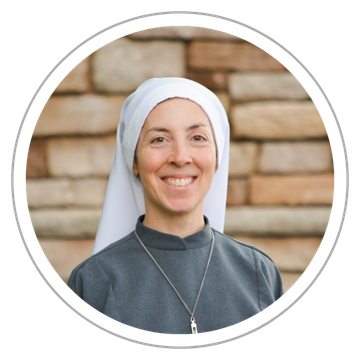
When asked how it was that I felt called to enter religious life, my thoughts immediately go back to about a year and a half before I entered our community. I had recently awakened from a night’s sleep, and out of nowhere I felt overwhelmed with this sense of the Lord’s presence. He was very close to me, and I had this sense of him asking me, “Will you let me be everything for you?” The experience was so powerful, it left me with a great joy in my heart and a great desire to respond wholeheartedly. There was no mention of religious life, yet I assumed that is what the call meant, and that is where my heart was being drawn. Within a few weeks, I had scheduled some “come and sees” with a few communities, ours being one of them. As I prepared to take this step forward, doubts started to creep back into my mind, questions, fears, etc. I also started to come to terms with what I would be leaving behind. If God was really calling me, then there was nothing to fear, but what if I had misinterpreted my experience? Thankfully, I went ahead with the visits in spite of these doubts.
The visits to each of the monasteries turned out to be quite difficult for me. After the last visit, I recall saying to the Lord, “I don’t want to live with a bunch of women; I want to live with one man. (Of course, in that moment, I wasn’t taking into consideration that I would be living with Jesus’ Eucharistic presence 24/7). I don’t desire this. If you want this for me, you have to help me desire it.” Then I didn’t give it another thought. I went back to life as usual.
It was about six months later that the desire returned. There was Something that stirred in my heart whenever I saw a consecrated person or read the writings of religious men or women and their experience of spiritual motherhood. So I called our community and a couple of others and started a journey of deeper discernment. There were still questions and fears, but the Lord continued to encourage me in many and varied ways, and it was enough to help me step out in faith and trust. In the summer of that same year, I entered the Franciscan TOR sisters as a postulant. The day of my entrance providentially fell on the feast of St. Teresa Benedicta of the Cross. This was a great consolation to me, as I had been asking her in recent months to pray for me in my discernment process. We were both teachers prior to our religious vocation, and we both entered religious life at an older than average age. I just felt that she, in particular, could relate to my fears and would feel particularly inclined to intercede for me. Another special grace of my entrance was that the Gospel reading at Mass on the morning of my departure from home contained the verse, “Put your hand to the plow and don’t look back.” This was the very thing I needed to hear because I had just come from sitting in my apartment struggling with saying goodbye to my life as I knew it. I loved my apartment; I loved my job and my students; I loved my family and friends; and of course, I loved my independence. “What if entering religious life wasn’t the Lord’s initiative?” I asked myself. “What if it was mine?” But those words from the Gospel felt like an encouragement from the Lord to move forward.
Of course, once one enters, one still has to go through the process of deeper discernment. I felt called to enter, but was the Lord calling me to stay? Our contemplative way of life, marked by much time for prayer and silence, gave me a much needed opportunity to pray with this question and to listen to God’s voice. Detaching from all the usual distractions I enjoyed, while difficult, allowed me to attach to the Lord in a new way. I was realizing more and more what he meant by his invitation to allow him to “become everything for me.” In my first year of novitiate, we were invited to pray with the Song of Songs from Scripture with the aid of- Blaise Arminjon’s book, Cantata of Love. On the surface level, the Song of Songs reads as a love poem. But it is also understood to be an allegory of the spiritual life--of God’s relationship with us.
Reading this work took me back to the memories of the conversion experience of my early 20’s. It was a point in my life in which I remember really falling in love with Christ; I could even say it was an experience of feeling inebriated with his love. Also, at that time, I really felt an innate call to love widely and broadly, as one might say. That is, my desire for a romance waned for a time, and I just wanted to love every person I encountered with the love of Christ. I just wanted them to know the joy of his love. I experienced friends, family, and co-workers responding to this love in very positive ways. This gave me great joy and contentment, but I didn’t really know much, if anything, about discernment at the time. It didn’t occur to me to pray with the question, “What is my personal vocation?” The only sense I had of my future was that I would take care of my parents when they became terminally ill. I somehow felt the Lord was entrusting me with and preparing me for this task.
Although I recall this sense now and can see how it came to fruition, it didn’t really inform any of my life decisions at the time. I pretty much just followed my feelings, including the desire for romance, once it returned. I didn’t stop and say, “Is this how the Lord is calling me to love? Is this the vocation I’m called to? Is there someone he wants me to be yoked to?” Rather, it was simply a matter of following my desires. As the years went by, there were times when I thought the Lord wanted me to marry a particular person, but looking back I understand that the Lord brought these persons into my life, not for the purpose of marriage, but rather so that I might one day understand on a deeper level the love he has for each of us, and so that I might recognize the vocation I was truly called to.
Back to novitiate, as I reflected on the Song of Songs, I could see threads of this poem in my own life. I could really identify with the woman of this story. I recalled the discovery of my “first love,” of Christ’s love, and how it far surpassed any “love” I had experienced prior. I could see how I failed to protect that love and how gradually and unknowingly I had been drawn back into the world, not always so much by choosing the bad, but by choosing the lesser of two goods. But one desire that never left me was the desire for all to know the love of Christ. It was a desire in need of deep purification, which is still a work in progress, of course. As I went through this process of purification, there were times of deep pain and darkness and an experience of the Lord’s absence. But this led me in a desperate search for him, and upon the experience of his return (not that he ever really left) I was starting to see how he used the circumstances of my life and my sufferings, often self-inflicted due to sin, to serve the purpose of deepening and sobering my love. In doing this, the Lord was allowing me to understand, even if to only some small degree, what his love for us cost him. Saving souls is costly.
If it was simply a matter of being loving and joyful, he wouldn’t have ended up on a Cross.
I recalled at one point when I was in the midst of spiritual turmoil, prior to community life, crying out to the Lord and asking for answers. I opened to a book containing messages from an alleged Marian apparition. I read the words, “I wish to draw you closer to my Son’s wounded heart.” I didn’t understand it at the time but I can now look back and recognize how often my heart was broken when I tried to share his love and I was rejected. I wanted to bring joy and happiness to another. I wanted to give all I had, but instead my intentions were so often completely misunderstood. In the case of myself, I could easily chalk it up to my own failures, my own misguided motives, my vanity, even my own idolatry in worst case scenarios. But this is not so for Christ. He loves humanity with a perfect, self-emptying love and is able to fulfill the deepest longings of our hearts, and yet so often, to a greater or lesser degree, we reject him. Yet he never responds by abandoning us; we need only look at a crucifix to see how he responds.
As I prayed with and reflected on all the above, I found a great tenderness towards our Lord welling up within me and an overwhelming desire to spend the rest of my days returning the love he so generously offers to us. Coming face to face with my own nothingness, my own awareness of how little, if anything, I have to offer, was initially a cause for fear. But the Lord quickly prompted me to hold to the truth that he doesn’t ask us to give what we don’t have but rather to open our hearts to the love he wishes to pour into it. We quench God’s thirst for us when we allow him to fill our own nothingness with his love. I just have to be little--like a child. A child so readily receives the love her parents lavish upon her, with no concern for her inadequacies.
So as I recognized a desire within myself to love the Lord with all my heart and to do what I could to console his heart, I continued to pray with the question of how. We are all called to allow God’s love to fill us, each in our own particular way. What was my particular way? Was I supposed to stay here? Was I supposed to return to my former post in the world after a time of renewal and healing? I didn’t want to leave, but I wanted to discern the Lord’s desires for me too. Yet the more I entered into our charisms, especially that of crucified love, the more I recognized within myself a call that had been present all along. It had been hard to embrace in the past. I had such a strong desire for marriage, which is natural, of course. But looking back, I realize I wasn’t discerning that call in freedom, for part of it was tied up in the need to prove that I wasn’t closed off to sexual intimacy just because I lived a countercultural life in terms of dating. It wasn’t until recently that I was able to let go of the fear of being misunderstood in this regard. But I finally was able to say, “Lord, you know the truth about me and that is all that matters.”
Little by little I became more confirmed in the belief that the Lord was inviting me to stay. There were so many ways in which he helped me recognize the call to spiritual motherhood and the call to pray from the standpoint of being with his mother at the foot of the cross ( too many to list here). But early on in my postulancy, a priest friend of ours mentioned a quote from St. Teresa Benedicta of the Cross that resonated so powerfully with me. She says, “Every time I feel my own powerlessness and inability to influence people directly, I become more keenly aware of the necessity of my own holocaust.” In hearing these words, I was more able to hear the Lord’s invitation to lay down my life in a holocaust of love. He wasn’t asking me to convince anybody of the truth. He knows I’m powerless to do that. He was simply asking me to love him and adore him, and more importantly, to let him love me, to let him be the fulfillment of all my desires. As I prayed with this, I was also able to more clearly see that this invitation had been presented to me repeatedly for years prior, but I wasn’t open to it at the time. I was convinced he had other plans for me.
While the call to religious life is a call to lay down one’s life, I have truly experienced the Gospel promise that it is in losing our life that we find it. Perhaps it required self-sacrifice at first, which I was only capable of, thanks to God’s grace. But I now see that I’ve offered nothing that I didn’t receive back from the Lord in a new way and I have ultimately been given everything. I’ve also come to understand that the life of a religious is not one devoid of Eros (by Eros I mean the experience of union with another). Rather it is a redirected Eros. The fire of this holocaust is every bit as consuming as any earthly love I had ever desired. But now my desires are redirected towards union with God and a thirst for the salvation of souls. I once heard a priest speak of the “wound of celibacy.” I appreciated him putting it that way as it really helped me to understand what I was embracing. In embracing the wound of celibacy, one doesn’t repress the desire for intimacy, or rise above it, or look disdainfully upon it, but rather one remains in the ache of longing; one remains empty so as to be filled with Christ. It is not a white-knuckled chastity in which one constantly looks at what has been sacrificed, but instead one looks at the pierced heart of Christ and asks for her heart to be expanded. At some point she realizes she can’t go back; she can’t look for her heart to be filled by a person. She has taken on the longing of Christ and her longing and her ache can only be filled by the salvation of souls. Her love can only be directed outward. Her motherhood becomes wholly given to the spiritual orphans in the world. It is in this way that Christ makes lifelong celibacy possible. He fills our life with all the beauty and mystery, which sometimes includes pain, of any earthly romance. So many pop songs speak of “dying” for a beloved. And apparently this sentiment speaks to us. The idea of a love completely given to the last drop appeals to us. This longing for a completely given love is fulfilled in Christ. He is humanity’s bridegroom and He did die for us. We, too, join him by dying to the earthly desires we once clung to in order to embrace heavenly ones.
The vows I have taken--of chastity, poverty, and obedience--have taught me to love in a new and deeper way. As I heard one friar put it, “Poverty is loving with hands nailed open. Obedience is loving with feet nailed down. And chastity is loving with a heart pierced open to all.” The vows call us to love in the image of Christ on the Cross. Poverty strips us of the self-reliance that prevents us from receiving gifts from the Lord. It is when we acknowledge our need that he is able to step in and help us in miraculous ways that increase our faith. Obedience is an act of trust in the Lord that deepens our awareness of his love. So many times in community I’ve gone where I didn’t want to go only to discover a gift from God waiting for me. And, as I touched upon before, the spousal love of Christ allows me to love others in a way that is proper to my particular vocation. He sustains my need for intimacy so that I can be present to the lonely and abandoned of society without being overcome by my own longing for companionship.
While I know my love is very feeble and limited, I also know that if I continually return to the foot of the Cross, my Savior is waiting to fill me with his love and mercy. Like everyone, I’m a very broken person, but when I lean into the call to be present to the Lord, to go where he asks me to go and to offer his love to those he puts in my path, I’m filled with an indescribable joy and an overwhelming awareness of the mercy he has shown me all my life.
Thank you for stopping by to read my testimony. May the Lord bless you and keep you and may his name be praised forever.
